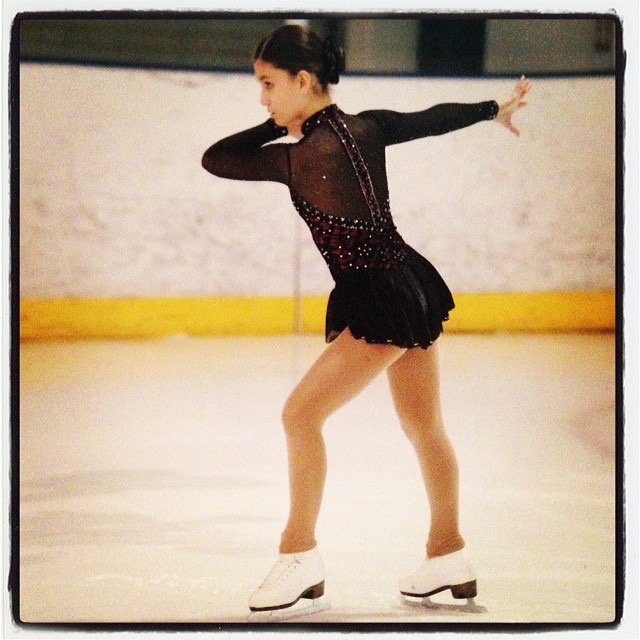
I was four years old the first time I stepped onto the ice.
It was a friend's birthday party at the local rink. I peeled off the puffy 90s layers my mom had bundled me in, found my balance, and, without anyone teaching me how, I jumped and turned a half-rotation in the air so I could wave at my parents. I wasn't scared, I was home.
That's the version of the story I like to tell; it’s the clean one.
The longer version is the reason I'm building Gradus.
The thing about falling
If you've never watched competitive figure skating up close, here's something you should know: a fall doesn't tell you anything by itself.
A skater can fall because she's rebuilding a jump from scratch — tearing down years of muscle memory on purpose, under a coach's instruction, because the old technique won't survive a triple. A skater can fall because she's exhausted, or distracted, or scared. A skater can fall because something inside her knee has quietly come apart, and her body is trying to warn her.
From the boards, every one of those falls looks identical.
I spent my childhood chasing this sport across the Chicago suburbs, and frankly, the entire Midwest. We changed coaches more times than I can cleanly count. First, Yvonne, then Margie, then an hour-long commute to Darien to train under a coach in the lineage of Carlo Fassi, the man who coached Dorothy Hamill. Then Monika, where I finally found my footing as a singles skater. Then, when puberty arrived, and a new coach started making comments about my changing body, we left again. Then my grandmother noticed my coach getting a little too attached to me, and we left the rink for good this time.
Each move meant relearning something: new technique, new takeoffs, new landings, new everything. By the time I was working with my last coaches, two sisters, Krisi and Kerri, I was spending twenty-plus minutes of every practice rebuilding the most basic jumps I'd landed easily as a little kid. We were re-engineering my shoulder, my rotation, my entries, all of it. It was the right call. It's also why I started falling on doubles I used to land in my sleep. We settled on this plan on a day my grandmother took me to practice.
So, my mom didn't know any of that.
The gap nobody could see
She saw the falls. She didn't see the plan.
She was driving me to that rink six times a week, twice a day, before and after school, often pulling me out early to make the commute. She was paying for it, sacrificing for it, living it alongside me. And from where she stood, her daughter, who used to land these jumps, was suddenly falling over and over again. To her, it didn't look like a technique problem; it looked like apathy, as if I had stopped trying.
I never told her the truth, because I was terrified that if she knew how much we were rebuilding, she'd think the coaching wasn't working, and we'd pack up and leave again. I'd lost too many coaches already. So I kept the plan to myself and just pushed harder. Fell more. Pushed harder. I thought if I just trained as hard as possible and got through the reps as quickly as possible, it would click, and then I'd be on the other side of this rebuild.
The pressure boiled over into something neither of us could stop. The car rides after practice turned into the worst part of my day. The arguments became a daily thing, at 4 AM, 7 AM, 3 PM, and 6 PM. My days were spent in tears, feeling smaller each day and completely out of control.
And somewhere in all that pushing, I tore my meniscus and ground away the cartilage in my right knee.
The injury went unnoticed for a long time because a fall from an injury looked exactly like a fall from rebuilding my technique, which looked exactly like the "lack of effort" my mom thought she was seeing. Three completely different stories, one identical picture. And no shared place where the coach, my mom, and I could see the same thing at the same time.
I eventually had the surgery and used it as an excuse to quit. I took a few years off to try horseback riding, where I had early success. Eventually, I came back to the ice on my own terms, through synchronized skating, which carried me all the way to a college team at Western Michigan.
I skated until the pressure from my mom started crossing statelines. I shared with her that I was skating the spots of Senior skaters, and my mom heard, "The coach wants her skating like a Senior skater." The pressure tripled. The tension on phone calls between us became untenable. I began to set every relationship I had with my teammates on fire at the demands of my mom. I would out-train, outshine, and push myself to be better than my peers, or else she was pulling me out. I knew I had to quit again. So I waffled all summer on returning for the fall and finally decided I was done days before tryouts.
We didn't speak much at the start of the next semester as I found myself exploring other extracurriculars and focusing on my education. On the day of my last final, I learned my mom had stage 4 cancer, and she passed away less than 30 days later.
We never repaired what skating broke between us. I want to be careful and honest here: she was not a villain. She was a mother who loved me, who gave up enormous amounts of her life for something I loved, and was unable to process what was actually happening on the ice. We were both doing our best inside a gap neither of us knew how to close. That gap cost me a lot more than just my knee.
I would give a great deal to have had one honest, shared window into all of it. A place where she could have seen: this is the plan, this is why she's falling, this is what we're building toward, and none of it is because she stopped caring.
That window didn't exist. So I'm building it.
The bunker in Scotland
For years I thought that chapter was just my history, then I became a sports parent.
My son is nine. He's a golfer, and he's been showing real promise since he was about five, right around the age I first took off on the ice. I know exactly what that fire looks like, because I've felt it. I also know what it can do to a family, because I've lived the other side of it.
In 2025, he was invited to play in the US Kids European Championships in Scotland. And during the first round, on an Open Qualifier course, I stood there and watched my son struggle at the bottom of a Scottish bunker, stuck in the sand, off his game, in front of everyone.
He'd done everything. Lessons. Golf almost every day leading up to it. Practice rounds. And there he was, struggling anyway.
What surprised me wasn't his struggle. It was mine. I stood there, flooded with frustration — not at him, at myself. I didn't have the words. I didn't have the skills. I didn't have the resources to have actually prepared him for that moment. I had spent my entire childhood inside an elite individual sport, and I still felt completely helpless on the side of that course, watching my kid and having no idea how to help.
And it hit me, standing there, that I had become my mom on the boards: loving, invested, sacrificing and almost entirely in the dark.
What I'm actually building
Gradus exists so that no parent has to stand at the edge of a bunker — or a rink, or a court, or a mat — feeling helpless, angry, and lost. And so that no kid has to carry the plan alone, hiding the truth out of fear, the way I did.
The insight underneath the whole thing is simple, and it's the one I learned the hard way: the problem in youth sports usually isn't a lack of effort or a lack of love. It's a lack of shared visibility. A coach holds the plan in their head. A parent watches the outcomes and fills in the blanks with fear. A kid sits in the middle, translating between two people who can't see what the other sees.
So Gradus is built to give the coach, the parent, and the athlete one honest, shared mirror of the development plan.
For coaches, it turns the methodology trapped in your head and your scattered notes into something structured, scalable, and yours — without burying you in forms between lessons.
For parents, it's a read-only, real-time window into the plan. Not surveillance. Not a way to micromanage the coach. Just the reassurance my mom never got: here's what's being built, here's why a hard stretch is happening, and here's the proof your kid hasn't stopped caring. Transparency, it turns out, is the actual cure for anxiety, not more control.
For young athletes, it's a daily roadmap and a record of their own progress over time, so the falls have context and the work has meaning. And your support system knows how to show up to be helpful, instead of harmful.
And because of where my own story went, safety isn't a feature I bolted on. It's the foundation. The communication is structured and visible by design — no private channels, no place for the relationship between a child and an adult to quietly drift somewhere it shouldn't.
I'm not building Gradus because youth sports needs more data. It has plenty. I'm building it because I know, in a way I wish I didn't, what happens when a coach, a parent, and a kid can't see the same thing at the same time.
I lost a lot inside that gap.
I'd like to make sure the next family doesn't have to.
If you're a coach, a parent, or someone who believes youth sports should build kids up instead of grinding them down — I'd love for you to follow along as we build Gradus. [Join the early list / reach out].
— Alyson